
Guides
Print guides
These guides answer the questions people ask before they order printing, from how to set up a file to which paper, fold or binding suits the job. Each one opens with the short answer, then gives the numbers and a checklist you can use at your desk.
- Serving Carmichael since 1965
- Most quotes within one business day
- Mon-Fri 9:00-4:30, one block off Fair Oaks Blvd
All pages in this section
Print-ready file checklist
A print-ready file is a PDF at the finished size with images at 300 pixels per inch, colors built in CMYK, 1/8 inch of bleed and all fonts embedded or outlined. Check...
Read moreWhat is bleed in printing?
Bleed is artwork that extends past the edge where the paper will be trimmed, so color or photos run cleanly to the edge of the finished piece. For most jobs, add 1/8...
Read morePDF export settings for print
Export your print PDF at the finished page size with bleed included, fonts embedded, images at about 300 ppi and color set to CMYK. Use a press-quality or PDF/X...
Read moreCMYK vs RGB: why colors shift in print
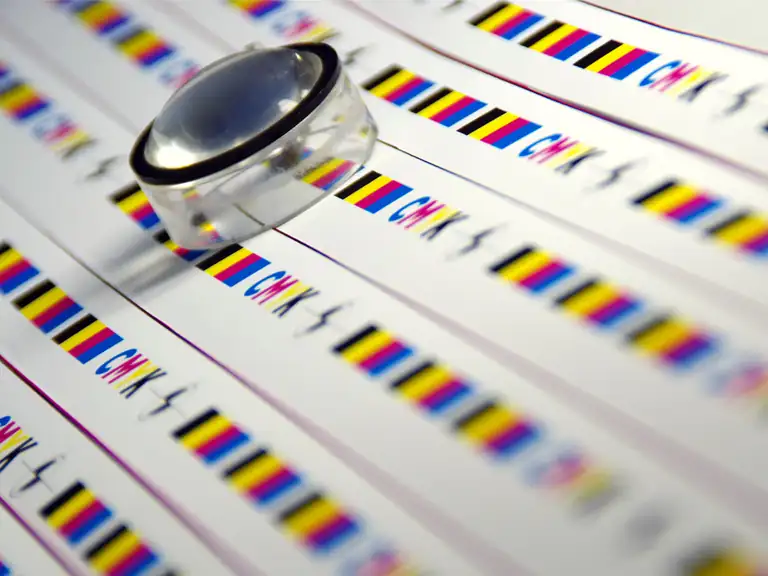
RGB mixes red, green and blue light for screens, while CMYK mixes cyan, magenta, yellow and black ink for print. Some bright RGB colors cannot be made with ink, so...
Read more300 dpi and image resolution, explained
For print, an image should have about 300 pixels per inch at the size it will be printed, so a 4 by 5 inch photo needs roughly 1200 by 1500 pixels. Web images are...
Read moreTrim, safe area and margins
The trim is the line where the paper is cut, the safe area is the space at least 1/8 inch inside it where text and logos stay, and the margin is the blank border you...
Read moreFonts, embedding and outlining for print
Embed fonts in your PDF, or convert text to outlines, so the printer sees the exact letters you designed. A computer that does not have your font installed will swap...
Read moreWhat is trapping in printing?
Trapping is a small overlap between two colors that touch, so that if the press plates shift slightly there is no white gap between them. A spread enlarges the...
Read moreProofs and approvals: what to check
A proof is the final type and artwork shown to you before printing, and your signed approval is what lets the job go to press. Check every word, number, date, image...
Read moreStandard US paper sizes: letter, legal, tabloid
The standard US paper sizes are Letter at 8.5 by 11 inches, Legal at 8.5 by 14 inches and Tabloid at 11 by 17 inches. Half-letter at 5.5 by 8.5 inches and other sizes...
Read morePaper weight explained: pounds and points
Paper weight in the US is the weight in pounds of 500 sheets of the paper's standard parent size, which is why 20 lb bond and 80 lb cover cannot be compared directly....
Read more14 pt vs 16 pt business cards
A 14 pt business card is 0.014 inch thick and a 16 pt card is 0.016 inch thick, so the 16 pt card is about 14 percent thicker and feels stiffer. Choose 14 pt for a...
Read moreCoated vs uncoated paper
Coated paper has a smooth surface layer that makes photos and color look sharp, in gloss, satin or matte finishes, while uncoated paper has a natural, absorbent...
Read moreBusiness card size and layout
The standard US business card is 3.5 by 2 inches, and a file with bleed is set up at 3.75 by 2.25 inches. Keep names and numbers inside a 3.25 by 1.75 inch safe area...
Read moreHow many flyers should I order?
Order the number of places or people you can realistically reach, plus a spare margin for mistakes and extras, for example 10 to 20 percent. Count your handout points...
Read moreHow many business cards should I order?
Estimate how many cards you hand out in a month, multiply by the number of months before your details are likely to change, and round up a little. Because a phone...
Read moreFlyer, brochure or postcard?
Use a flyer for one quick message on a single sheet, a brochure when you need to explain several things in folded panels, and a postcard for a short message that can...
Read moreBrochure folds: tri-fold vs Z-fold and more
A tri-fold folds a sheet into thirds to make six panels with one panel tucked inside, and a Z-fold zigzags the panels back and forth like an accordion, so it opens...
Read moreBooklet page counts and creep
A saddle-stitched booklet needs a page count that is a multiple of four, because each folded sheet makes four pages. Creep is the way inner pages push outward when...
Read moreSaddle stitch vs perfect vs coil binding
Saddle stitching wire stitches folded sheets through the centerfold for thinner booklets, perfect binding glues pages to a flat, square spine like a paperback, and...
Read moreWhat is carbonless (NCR) paper?
Carbonless paper, also called NCR paper for "no carbon required," is coated paper that copies pen or typewriter pressure onto the sheets under it without any carbon...
Read moreHow to design a carbonless form
Design a carbonless form around the pen: leave fields large enough for handwriting, keep lines dark and simple, and decide the sheet order and copy labels before you...
Read moreNumbering and perforating forms
Numbering prints a unique, consecutive number on every form so each one can be tracked, and perforating cuts a line of small holes so part of the sheet tears off...
Read moreStandard envelope sizes
The standard US business envelope is the No. 10, which measures 4 1/8 by 9 1/2 inches and fits an 8.5 by 11 inch letter folded in thirds. Carmichael Printing prints...
Read moreLetterhead and envelope set checklist
A letterhead and envelope set needs your logo, contact details, a paper choice and a layout that works on both the sheet and the envelope. Carmichael Printing prints...
Read moreHow USPS Every Door Direct Mail works
Every Door Direct Mail (EDDM) is a USPS program that lets you mail a flyer or postcard to every address on chosen carrier routes without a mailing list. EDDM Retail...
Read moreEDDM vs a targeted mailing list
EDDM reaches every address on the carrier routes you choose with a generic "Postal Customer" piece, while a mailing list reaches specific named people you pick....
Read moreLetter vs flat: USPS mailpiece sizes
The USPS calls a mailpiece a letter if it is at most 11 1/2 by 6 1/8 inches and 1/4 inch thick, and a flat once it is larger than that in any one dimension, up to 15...
Read moreWhat is a mail merge?
A mail merge combines one reusable document with a list of recipient data, so you get a personalized copy for every name on the list. Carmichael Printing handles mail...
Read moreMailing list cleanup basics
Cleaning a mailing list means removing duplicates, writing every address in one consistent format and fixing gaps before a single piece is printed. A clean list means...
Read moreHow to plan a print job timeline
Plan a print job by working backward from the date you need it in hand, and allow time for the quote, the file check, the proof, your approval, printing, any...
Read moreHow to get an accurate print quote
An accurate print quote needs the quantity, the finished size, the paper, the ink colors, the finishing, the state of your files and the date you need it. Give...
Read moreHow to reprint a piece without the original files
To reprint a piece without its original files, bring a clean printed copy and a list of changes, and the shop will scan or rebuild it as a new print-ready file....
Read morePrinting school forms and student cards
School forms such as emergency cards, enrollment sheets and cum and health folders are best planned a year at a time, starting from last year's copy with the changes...
Read moreChurch bulletin and program printing tips
A church bulletin is usually a letter-size sheet folded in half, giving four pages of 5.5 by 8.5 inches, and it prints best from a fixed template you reuse each week....
Read moreNewsletter layout and mailing checklist
A printed newsletter works best with a fixed format, a clear layout grid and a mailing panel planned before the first article is placed. Carmichael Printing designs,...
Read moreRestaurant menu printing options
Restaurants print menus as single disposable sheets, laminated or covered reusable menus, placemats and table tents, and the right choice depends on how often your...
Read morePolitical mailer checklist for California
California campaign mailers must carry the disclosure the Fair Political Practices Commission (FPPC) requires, in its basic form "Paid for by [committee name]," and...
Read moreLamination: options and when to laminate
Laminate a printed piece when it will be handled, wiped, folded or displayed often, because a thin plastic film protects it from creases, fading, water and...
Read moreWhat is thermography (raised printing)?
Thermography is a printing process in which a powder is added to wet ink and then heated, so the ink rises into raised lettering with a look similar to engraving....
Read moreCarmichael Printing has been answering these questions at the counter since 1965, and the guides put the same answers in writing. The file-setup guides follow what our prepress desk asks for every day: a PDF, 300 ppi images, CMYK color and 1/8 inch of bleed. The paper and product guides help you choose before you ask for a quote. If a guide leaves your question open, call the shop or send the file and we will look at it with you.
Where to start
If you have a file ready, begin with the print-ready file checklist. If you are still deciding what to print, flyer, brochure or postcard narrows the choice quickly, and standard paper sizes shows what fits on a sheet.
Guides that deal with a single product, such as business cards or booklets, link to the matching product page so you can see what we print and what to tell us for a quote.
Are the guides specific to Carmichael Printing?
The numbers are industry standards, and where our shop has its own setup rules, such as the 1/8 inch bleed and 300 ppi images, the guide says so.
Who do I ask if my file question is not covered?
Call the shop Monday to Friday, 9:00 am to 4:30 pm, or email graphics@carmichaelprinting.com with the file or the question.
Start a job
Tell us about your print job.
Send what you know: the piece, the quantity, your file if you have one. Just tell Tony what you need.
(916) 487-8679Monday to Friday, 9:00 am to 4:30 pm. Or stop by 5757 Robertson Ave, Ste B, one block off Fair Oaks Blvd.
- Serving Carmichael since 1965
- Most quotes within one business day
- Mon-Fri 9:00-4:30, one block off Fair Oaks Blvd